panthema / tags / fun

The Sound of Sorting demo programPublished "The Sound of Sorting" 0.6

Posted on 2013-05-22 23:50 by Timo at Permlink with 0 Comments. Tags: c++ university fun sorting

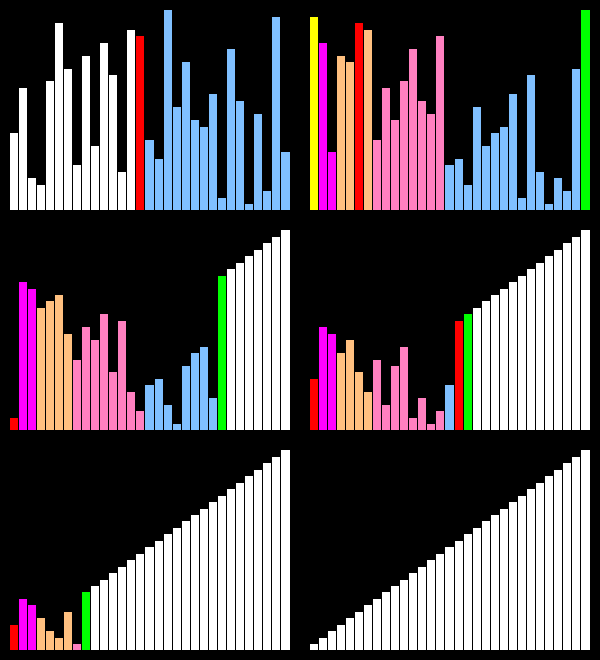
This post announces the publication of my demo program for integer string sorting algorithms, called "The Sound of Sorting". It both visualizes the internals of sorting algorithms, and generates sound effects from the values being compared!

The demo is implemented using the cross-platform toolkits wxWidgets and SDL, can be executed on Windows, Linux and Mac, and runs in real time.

There are also many videos of the sorting algorithm on my new YouTube channel.

See the Sound of Sorting project page for the demo program and source code, and more information about version 0.6.

Thumbnail of Escher's Relativity in LegoReally Good Lego Model of Escher's "Relativity"

Posted on 2007-09-07 10:41 by Timo at Permlink with 0 Comments. Tags: fun

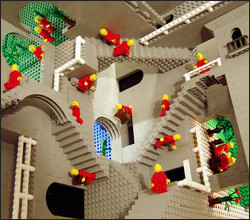
The idea strikes me as very strange: to take the impossible figures sketched by Escher and build Lego models of them.

Someone actually took up this seemingly "impossible" feat. Yesterday I found their pictures of "Relativity", of which I have a poster on the wall left of my PC. I've had some long looks at the poster. So the minute details of the Lego reconstruction interested me immediately. Due to the studs of (standard) Lego tiles pointing in only one direction they had to leave out a few railings, which help form the twisted triangle's composition lines. Each of the red Lego men are at the correct place and hold the correct action props. Sweetest are the Lego flowers and plants positioned at the picture's upper left, lower right and center. A very good job indeed.


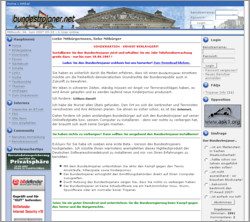
Screenshot der Webpage www.bundestrojaner.netSpaß-Webpage - Bundestrojaner.net

Posted on 2007-06-06 09:38 by Timo at Permlink with 0 Comments. Tags: fun

Online-Durchsuchungen sind zur Zeit wieder auf der politischen Tagesordnung, denn "Das Internet ist das entscheidende Kommunikationsmittel des internationalen Terrorismus [...]" (Zitat vom BKA-Chef auf tagesschau.de).

Windows wird aber nicht in Deutschland entwickelt und daher kann das BKA nur schwer bei Microsoft ein eigenes Backdoor beantragen. Das (angeblich) bereits vorhandene Backdoor der NSA kann wohl rechtsstaatlich nicht verwendet werden.

Daher ist es notwendig ein "Bundestrojaner" auf den zu untersuchenden Rechnern zu installieren. Dieses (Schad-)Programm soll dann vom BKA ferngesteuert die Festplatten durchsuchen.

Auf www.bundestrojaner.net gibt es bereits eine Betaversion zum Ausprobieren. Nein, nicht wirklich: es ist eine mit vielen politischen Sprüchen aufgemachte Satire-Webpage. Durch Appelle an unseren Patriotismus und Glauben an rechtsstaatlichen Grundsätze wird man aufgefordert den "Bundestrojaner" herunterzuladen und sich freiwillig durchsuchen zu lassen. Hier einige Zitate:

Seien Sie ein guter Demokrat und unterstützen Sie die Bundesregierung beim Kampf gegen den Terror und die Bürgerrechte.

Sie haben nichts zu verbergen? Dann sollten Sie umgehend den Bundestrojaner installieren!

Leider ist das downloadbare Programm nicht sehr ausgereift: es zeigt (anscheinend) nur eine kurze Slideshow-Sequenz und bittet den Benutzer um "Geduld, Ihre Daten werden übertragen".

Außerdem hat der CCC am 1. April diesen Jahres bereits den "Bundestrojaner" ausgemacht: in der Elster-Software des Finanzamts.


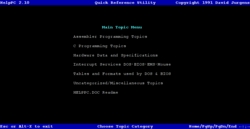
Front Page of HelpPC HTML versionNostalgic HTML Conversion of the HelpPC Shareware Reference

Posted on 2006-07-10 15:00 by Timo at Permlink with 4 Comments. Tags: helppc fun

Browse the converted HelpPC Reference Library

The HelpPC Shareware Reference is an collection of reference information from 1991 concerning the PC and PS/2. It was created by David Jurgens and includes a hypertext viewing program for DOS. The reference library may be old, but many parts are still applicable to present-day PCs.

During some nostalgic moments I remembered the fun and motivation I received out of this reference during my early programming years. I found out that only a very crude transcription into HTML existed on the web at http://heim.ifi.uio.no/~stanisls/helppc/and decided to create one which is more true to the source.

Main Goal for the new converter was to retain the look and feel of the old DOS hypertext program: the use of CSS including the pseudo-class "hover" allowed me to create a HTML page with remarkable similarity. The special ASCII character are not included in the standard HTML entities, however the can be found in the Unicode character table. The converter uses a carefully picked set of Unicode dingbats and line symbols to replace the undisplayable control characters. Thus the HTML pages contain no images and can be displayed by any browser utilizing Unicode fonts. All current-day browsers (Firefox 1.5, IE 5, Opera 9.0) display these symbols well.

You may browse the converted files and can download an offline version: as a zip archive (1.2 MB) or a tar.bz2 archive (257 kB).

The converter itself is a Perl script which requires the Template Toolkit and the original HelpPC distribution. All output files are valid XHTML 1.0 Strict. To run the converter download the following files from on of the locations:

Original HelpPC distribution (255 kB) from Simtel.NET local copy
Converter Perl Script (15 kb) download display code

Extract the zip file and run the Perl script in the path containing the .TXT files. The script will create a subdirectory "html" with 1015 XHTML files. You can modify the nostalgic.css or the embedded text templates to fit your taste.


RSS 2.0 Weblog Feed Atom 1.0 Weblog Feed Valid XHTML 1.1 Valid CSS (2.1)